
Poems were one of the most potent means of cultural memory in the UAE long before the country was known for its modern cities, bold architecture and international business hubs. Verses passed on family histories, personal feelings, social values, and descriptions of the natural environment from one generation to the next.
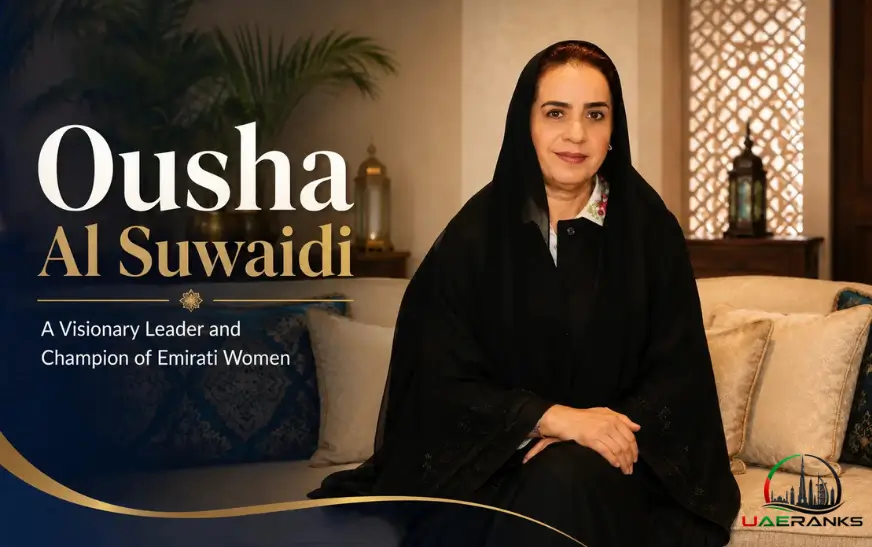
Ousha Al Suwaidi is one of the poets who contributed to the preservation of this heritage.
She was born Ousha bint Khalifa Al Suwaidi and was one of the most esteemed voices in Emirati and Arabian Gulf literature. She was particularly renowned for her mastery of the Nabati poetry, a vernacular poetic tradition that was closely tied to the everyday language and experience of people in the Arabian Peninsula.
Ousha, also known as Fatat Al-Arab, or “Girl of the Arabs,” wrote poetry about love, wisdom, faith, nostalgia, patriotism and the landscapes of the UAE. Her literary success also led to the recognition of women in a field that had traditionally been dominated by male poets.
Ousha Al Suwaidi, at a Glance
- Ousha bint Khalifa Al Suwaidi was born in Al Ain in 1920.
- In her teens, she was a nationally known recitalist of poetry.
- Her poetry was closely linked to Emirati Nabati poetry.
- She was initially dubbed “Girl of the Gulf” and subsequently “Girl of the Arabs.”
- Her poems were about love, wisdom, praise, faith, patriotism and local heritage.
- Her poems were set to music by several Emirati and Arab singers.
- Her accomplishments paved the way for future generations of Emirati women poets.
- She passed away in 2018 at the age of 98, leaving behind a legacy of influence in the literary world.
| Feature | Details |
|---|---|
| Full Name | Ousha bint Khalifa Al Suwaidi |
| Famous Title | Fatat Al Arab (Girl of the Arabs) |
| Profession | Emirati Poet |
| Poetry Style | Nabati Poetry |
| Known For | Traditional poetry and cultural influence |
| Contribution | Preserving Emirati heritage through literature |
| Legacy | One of the most respected figures in Gulf poetry |
Early Life in Al Ain
Ousha Al Suwaidi was born in Al Ain in 1920, when the region was defined by strong family bonds, oral history, trade, farming, pearl fishing and the exchange of people between the desert and the coast.
Poems and books were a big part of her family’s life. Poets visited the family home, giving the young Ousha opportunities to listen to recitations, observe the construction of verses and become familiar with the rhythms of Arabic poetry. This setting enabled her to make poetry a part of her everyday life.
The images in her surroundings were also a rich source for her work. The desert, palm trees, dunes, animals, rain, the sea and familiar places were not just filler. They were symbols through which she remembered, longed, gave generously, was determined and belonged.
Ousha lived in Al Ain for most of her life, except for about 15 years in Qatar. Later she relocated to Dubai in the late 1980s. The various geographical experiences broadened her knowledge of the Gulf society and deepened her appreciation of the language, culture and environment of the UAE.
The Discovery of Poetry at an Early Age
Poems were Ousha’s first love. She was composing and reciting verses by her early teens. She was recognized by the poetry community at about 15 years old, which is quite an accomplishment for a young person.
Her success was even more remarkable given the male-dominated public poetry scene of the time. Women were involved in oral culture and sometimes wrote poetry, but not always had the same opportunities to circulate their work or recite it publicly.
Ousha defied this trend with her writing quality and confidence. Her poems were memorized and recited, and her reputation spread before the advent of modern publishing and digital communication.
She was not just a natural. Her development was the result of years of careful listening, memorization and experimentation with rhyme and meter. She learned the poetry of classical Arabic poets like Al-Mutanabbi, Abu Tammam and Al-Ma’arri. She was also inspired by great Nabati poets such as Al Majidi bin Thahir, Rashid Al khalawi, Saleem bin Abdul Hai and Mohsin Hazzani.

What Is Nabati Poetry?
To appreciate the importance of Ousha Al Suwaidi, it is important to understand the Nabati poetry.
Nabati poetry is a traditional Arabic vernacular poetry of the Arabian Peninsula. Nabati verse is written in a style of Arabic that is more similar to the local spoken language than to formal literary Arabic. It is sometimes referred to as popular poetry, vernacular poetry or the “people’s poetry.”
In the past, Nabati poems were recited orally. Verses were memorized and recited at family gatherings, social events and community meetings. Poems might be used to share information, to document events in history, to honor a person of importance, to give guidance, or to share personal feelings.
It is commonly used for the following subjects:
- Love and separation
- Tribal and national identity
- Courage and loyalty
- Hospitality and generosity
- Social behavior
- Religious devotion
- Desert and marine flora and fauna.Flora and fauna of desert and sea.
- Praise, satire and poetic correspondence
Its language is conversational, but Nabati poetry is highly technical. Poets need to master the rhythm, rhyme, imagery and vocabulary, and need to make sure that a poem is natural when spoken aloud.
Ousha Al Suwaidi learned these requirements. Her poems were easy to listen to, but also full of metaphor, cultural references and well-structured sounds. Her work proved that vernacular poetry could be rich in philosophical and emotional content.
Major Themes in Ousha Al Suwaidi’s Poetry
Ousha Al Suwaidi’s poetry is not limited to a single theme. Her work encompassed personal, social, national and spiritual experiences.
Love, Longing and Separation
One of the most familiar motifs in Ousha’s poetry was love. She wrote about love, emotional separation, fidelity, loss and the lingering aftertaste of a relationship that has evolved.
She did not talk about emotions in abstract terms, but often linked emotions to physical environments. A faraway location may symbolize distance, and shifting weather may indicate uncertainty or newfound hope. This connection between emotion and environment infused her romantic poetry with a distinctly Gulf flavor.
Wisdom and Human Behavior
Ousha’s verses are many that discuss patience, dignity, fortune and the unpredictable nature of human relationships. Her observations tend to shift from a particular situation to a general lesson in life.
For instance, the act of diving for pearls might be a metaphor for hard work and unpredictable outcomes. A diver can go into the sea with skill and determination and come out without a valuable pearl. Through such imagery, Ousha could communicate ideas about perseverance, destiny and disappointment without using formal philosophical language.

Emirati Landscapes and Cultural Memory
Ousha Al Suwaidi’s poems often feature the desert and the sea. She wrote about dunes, palms, local animals and familiar places, making geography a record of Emirati identity.
These details enable modern readers to appreciate how people lived in the UAE before the rapid urbanisation. Her poetry captures the look of the surroundings as well as the feelings that go with them.
The land might symbolize stability and belonging. Travel may be a change or a distance. Rain might indicate renewal, the sea might indicate danger, opportunity, or the search for something valuable.
Patriotism and Praise
Ousha wrote poems about her country and her great national heroes. Praise poetry is an ancient art form in both classical Arabic and Nabati traditions, but it is not just about admiration. The poet is required to choose images that convey leadership, courage, generosity and public responsibility.
Her patriotic poetry also linked the growth of the UAE to the values passed down from previous generations.
Faith and Spiritual Reflection
Her devotion to religion was another important aspect of her work. One of her most important works is a poem praising the Prophet Muhammad, according to her official biography.
These spiritual verses demonstrate the range of her poetry. She could shift from romantic longing and social observation to religious praise, and keep her unique command of language and rhythm.
Language, Imagery and Poetic Style
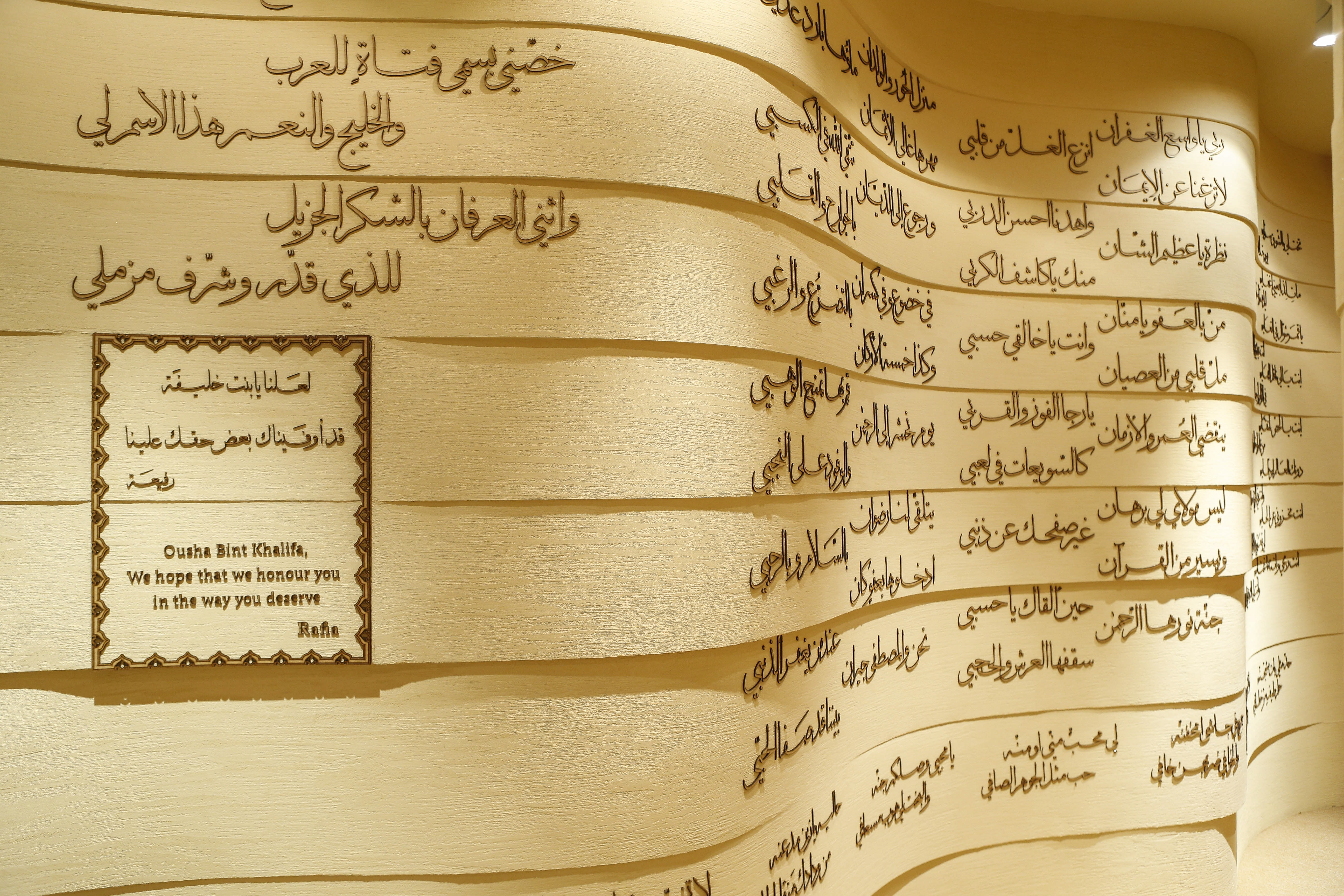
Ousha Al Suwaidi’s style was simple yet profound. Her poems were accessible to the general listener, but were also structured to demand careful reading.
Her most powerful asset was her ability to take commonplace images and make them new. Gulf poets already had a vocabulary of falcons, gazelles, pearls, dunes, palms and shifting weather. They were not included in Ousha simply because tradition called for them. She chose each picture for the emotional or philosophical meaning of the poem.
She also had a reputation for writing:
- Carefully controlled rhyme and meter
- Musical phrasing appropriate for oral delivery
- Vivid descriptions of desert and coastal environments
- Metaphors based on Emirati life.
- The flow of intimacy and publicness
- Language that is influenced by both Nabati and classical Arabic traditions.
- Multiple layers of meaning that can be interpreted in various ways
Her command of sound is one reason why her poetry was so effective in recitation and music. A poem that is meant to be heard should have rhythm, but not be forced. Ousha found this balance by choosing words that had meaning and flowed from one line to the next.
Translation is difficult because some Gulf Arabic phrases may have cultural connotations that do not have an exact match in English. Literal translation may convey the general meaning but not the rhyme, emotional tone or regional significance of the original language.
The Meaning of “Girl of the Arabs”
Ousha was originally called Fatat Al-Khaleej, which translates to “Girl of the Gulf.” Her name was a testament to her rising profile in Gulf poetry.
In 1989, Sheikh Mohammed bin Rashid Al Maktoum dedicated a poem to Ousha after a series of poetic exchanges, and named her Fatat Al-Arab, or “Girl of the Arabs.” The new title implied that her literary significance was not limited to the Gulf but extended to the broader Arabic-speaking community.
The title is not to be interpreted as a ceremonial nickname. It was a sign of recognition from a well-known poet and national leader who appreciated her technical ability and contribution to Arabic culture.
The “Girl of the Arabs” is still closely linked to the Ousha Al Suwaidi biography, and is featured in cultural programs, exhibitions, literary discussions and educational materials dedicated to her work today.
A Pioneering Voice for Emirati Women
Ousha’s career helped to shift the attitude towards women’s involvement in Gulf poetry.
She managed to do so in a literary world where men were more likely to be recognized. She was not just an unusual female participant, but a respected poet through craftsmanship, consistency and knowledge of poetic tradition.
There are several ways to appreciate her impact on Emirati women poets. She demonstrated that women could write technically complex Nabati poetry, engage in poetic dialogue, and create a following outside of the private sphere of family. She also recorded her own recitations, which enabled listeners to hear the poet’s voice in the written verse.
Her success did not keep her from Emirati culture. Rather, she showed that a woman could be a literary voice and yet be very much a part of the local language, religion, history and social norms.
Ousha had already carved out a respected niche in the cultural landscape, making her voice more audible to later poets.
Publication, Recordings and Musical Adaptations
Ousha Al Suwaidi’s poetry was read, published in newspapers, magazines and on audio recordings for much of her career. The sound and rhythm of a poem are crucial to its impact, particularly in the case of Nabati poetry, which was especially significant in these formats.
The first book of her poetry was compiled in 1990 by poet Hamad bin Khalifa Bou Shehab. A second edition was published in 2000. Dr. Rafia Ghubash published an official biography in 2011 dedicated to Ousha’s life and literary works.
A number of Emirati and Arab singers also performed songs based on her poems. Musical adaptation brought her writing to people who might not have read her poetry books or attended her formal recitals.
Her words traveled from generation to generation and from place to place in the Arab world through print, recorded recitation and music.

Awards and Cultural Recognition
Ousha was honored in many ways both in her lifetime and posthumously.
In 2010, she was awarded at the 11th Sharjah Festival of Classic Poetry and the Abu Dhabi Award. In her honor, an annual award for Emirati women poets was launched and the Women’s Museum in Dubai dedicated a section to her life and work.
She was named the Personality of the Year in 2014 by the Emirates Airline Festival of Literature for her contribution to Arab literature.
Ousha died in 2018 at the age of 98. She was posthumously awarded the Abu Dhabi Festival Award in 2019 for her literary wisdom and creativity in Emirati and Arab culture.
On November 28, 2022, Google honored her with a special Doodle. The Doodle, created by Emirati artist Reem Al Mazrouei, brought Ousha’s story to the international community and showcased her contribution to women poets.

Ousha Al Suwaidi’s Lasting Legacy
Ousha Al Suwaidi is still significant because her poetry is a link between literature and cultural history.
Her writing is a testament to the artistic potential of the Nabati style of poetry for those who enjoy reading literature. She employed a regional style to convey emotions and ideas that are universally understood.
Her poems are a cultural historian’s treasure trove of information on Emirati landscapes, relationships, hospitality, travel and community values. They provide a creative account of a society in a period of significant social and economic change.
Her life is a testament to authority gained through artistic excellence for women writers. She was not influential just because she was one of the few women who were publicly known in her field. Her poetry was influential because it could be placed on a par with the work of the leading writers of her generation.
Her legacy can thus be summarized in four interrelated contributions:
- She reinforced the role of Nabati poetry in UAE literature.
- She maintained Emirati heritage in language and images.
- She opened up public space for women’s poetic voices.
- She connected oral tradition with print, recordings and popular music.
Conclusion
Ousha Al Suwaidi made personal experience and familiar Gulf landscapes into a common literary legacy. Her poetry is about love, faith, identity, wisdom and belonging, and it maintains the vocabulary and cultural memory of the Emirates.
The title “Girl of the Arabs” was more than a recognition. It was a testament to her talent for making a regional poetic tradition resonate throughout the Arab world.
Ousha’s verses are still studied, performed and remembered decades after her first recitations. Her most important accomplishment was not just writing beautiful poetry. It was demonstrating how local language, everyday experience and inherited tradition could be a lasting document of a nation’s cultural soul.
FAQ’s
1.Who Was Ousha Al Suwaidi?
Ousha Al Suwaidi was an Emirati poet and one of the most prominent poets of the Nabati genre and cultural literature of the UAE.
2. What Was the Name of Ousha Al Suwaidi?
Her name was Ousha bint Khalifa Al Suwaidi. She was also popularly known as Ousha the Poet.
3. Where and When Was Ousha Al Suwaidi Born?
Born in Al Ain, Emirate of Abu Dhabi in 1920.
4.Why Did She Get the Nickname “Girl of the Arabs”?
In 1989, she was awarded the title “Girl of the Arabs” by Sheikh Mohammed bin Rashid Al Maktoum, which superseded her previous title, “Girl of the Gulf.”
5. What Type of Poetry Did Ousha Write?
She was most famous for her work in the vernacular Arabic poetic tradition of the Arabian Peninsula, known as Nabati poetry.
6. What Were the Main Themes of Her Poetry?
Her poems were about love, wisdom, faith, nostalgia, praise, patriotism and the desert and coastal landscapes of the UAE.
7. What Did Ousha Do to Help Women Poets?
Her public success brought Emirati women to the fore and inspired future generations to take part in poetry and cultural activities with confidence.
8. Were Ousha Al Suwaidi’s Poems Published?
Yes. She published her first collected poetry book in 1990 and a second in 2000.
9. Were Her Poems Used in Songs?
Yes. Her poems were set to music by several popular Emirati and Arab singers.
10. When Did Ousha Al Suwaidi Die?
Ousha Al Suwaidi passed away in 2018 at the age of 98. Her poetry remains a source of inspiration for Emirati literature and cultural education